Q: What is a thesis statement? Where should it be?
Look at the following slides and find your answer.
Take a look at these Sample Academic Paper Introduction Paragraphs, and answer the questions thereafter.
Here is a good example of thesis statement from the New York Times.
You can find the tips to write efficient thesis statement here and here.
Let's do some practice now!
Exercise 1 & Exercise 2
Q: What is a parallel structure?
A: Using the same pattern of words, phrases or clauses in writing to show two or more ideas have the same level of importance.
Here are some examples.
More Practice!
Day 4 (Sep 3) - Audience, Purpose & Tone
1. Do you talk in the same way all the time? Even to different people?
2. What do you think is the cause of it?
Q1. Academic Writing Purpose
Academic writing purpose depends on the assignment. Some tasks include:
1) Explaining an issue
2) Making an argument
3) Analyze a work (paper, movie, book) by someone else
Your major papers in ESL115 will all involve some form of evidence-based ARGUMENT.
What is the purpose of each of those papers?
1) “Scenes of Smoking in the Movies Create Unhealthy Habits among Teenagers”
2) “Influence On Students’ Development: Comparison of Single-Sex vs. Coeducational School”
3) “Get to Know Eating Disorders”
4) “The Examined Elite: Report and Reflection on Nicholas Lemann’s The Big Test”
Q2. Targeting Your Audience
What is your audience? Who read your papers? How would you describe your audience?
Keep in mind that your academic audience:
1) is well-educated and intelligent;
2) expects your paper to flow logically;
3) may not be knowledgeable of your specific topic;
4) may not be familiar with the sources you have read;
5) is looking to see that you understand the material;
6) may or may not agree with your assumptions
Look at the chart show in here and discuss with your partner.
Q3. Tone in Academic Writing
Formal tone
1) Avoid contractions, slang, informal figures of speech
2) Avoid hyperboles and clichés
Objective tone
1) Show your opinion with your evidence, don’t tell.
2) Leave yourself and the reader out of it. Avoid using the 1st person (I, we) and 2nd person (you).
3) Avoid phrases like “I think”; “I believe”; “It’s right that”; “It’s wrong to”; etc.
Here you can find a list of words and phrases you need to avoid in your own writing, but this is not all!
Day 3 (Aug 29th) - Communication Model & Writing Across Borders
1. Warm-up Questions
1) Have you ever had any miscommunication experience with others, especially with someone from a different cultural background?
2) What do you think is the cause for miscommunication?
2. Introducing the "Communication Model"
Communication Model video link on Youtube: https://www.youtube.com/watch?v=QDoZZQlCjA4
So basically, you have to know your audience so as to make the right choice to avoid miscommunication. Here is a video that tells you how to do American Handshakes.
3. Writing Across Borders
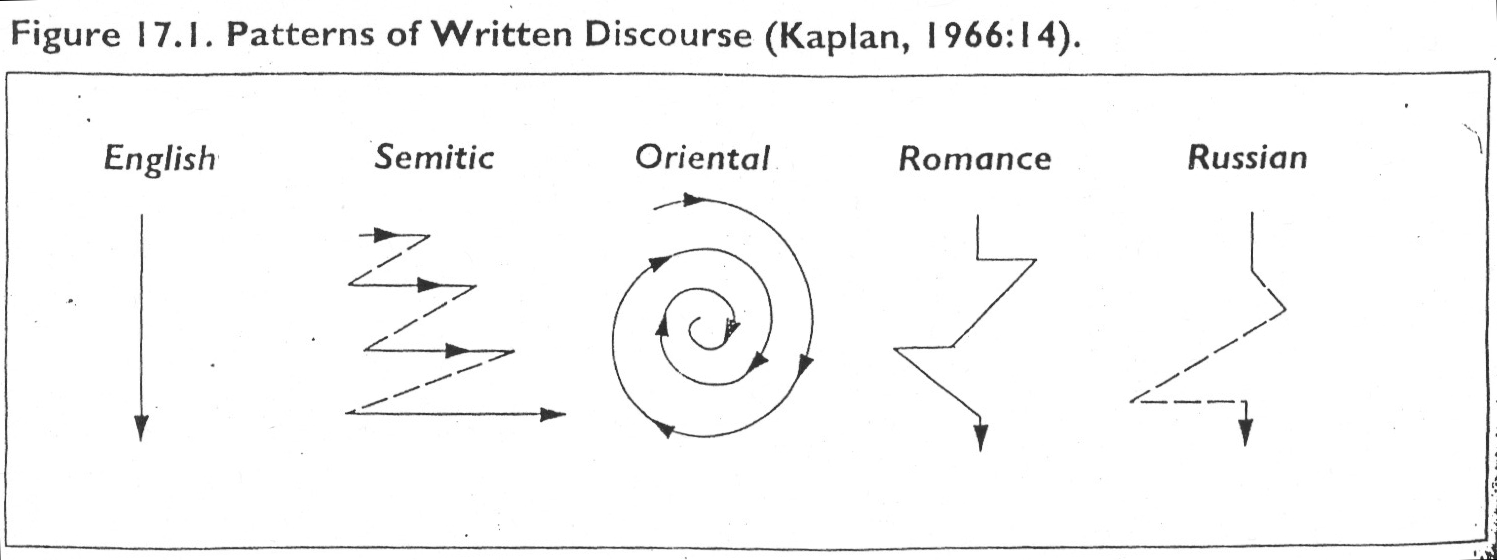
See the Contrative Rhetoric ppt in Google Drive.
ANNOUNCEMENT: No Class on Monday, September 1!
Day 2 (Aug 27th) - Diagnostic Exam!!!
Yeah! Diagnostic Exam on Wednesday! Make sure that you arrive early (at least 2:55 pm for the ESL115 K class and 3:55 pm for the ESL115 A1 class) so that we can administer the exam right on time.
There are several things that you need to keep in mind in the diagnostic exam.
1. Use of cellphone, internet or dictionary is prohibited during the diagnostic exam.
2. After you are done, you will submit your exam through Compass 2g and keep no copy to yourself. The
prompt of the exam has to be remained confidential.
3. Any form of cheating or plagiarism will be punished! Don't even think about it! Or you may look like this
poor little kitty:
Remember that the purpose of this diagnostic exam is for me to find the problems you have in writing, and for you to review the basic essay structure and be aware of any potential problems you may have in writing. Therefore, treat the diagnostic exam seriously, but don't be overwhelmed or even terrified by it. Enjoy!
Since I will use Compass 2g to collect you exams, make sure that your Compass 2g works and it shows
There are several things that you need to keep in mind in the diagnostic exam.
1. Use of cellphone, internet or dictionary is prohibited during the diagnostic exam.
2. After you are done, you will submit your exam through Compass 2g and keep no copy to yourself. The
prompt of the exam has to be remained confidential.
3. Any form of cheating or plagiarism will be punished! Don't even think about it! Or you may look like this
poor little kitty:
Remember that the purpose of this diagnostic exam is for me to find the problems you have in writing, and for you to review the basic essay structure and be aware of any potential problems you may have in writing. Therefore, treat the diagnostic exam seriously, but don't be overwhelmed or even terrified by it. Enjoy!
Since I will use Compass 2g to collect you exams, make sure that your Compass 2g works and it shows
on the right column of your website. If not, contact me as soon as you can at xinliu6@illinois.edu, and I will try to help you sort it out.
Don't forget to purchase your Writer's Help ebook online through http://pages.mail.bfwpub.com/WritersHelp/Student_Ordering_Info/.
In addition, there are severl links that might be of great help to you, and they are listed below.
Writer's Help Student Orientation: https://www.youtube.com/watch?v=sKQAAhEOhek
Student Guide to Writer's Help: http://image.mail.bfwpub.com/lib/feed1c737d6c03/m/1/WH_StudentGuide_v4.pdf
Student F&Q for Writer's Help: http://support.bfwpub.com/index.php?View=entry&EntryID=322
Switching Instructor: http://support.bfwpub.com/index.php?View=entry&EntryID=393 (This is very important for you when you first log in and select your instructor)
Day 1 (Aug 25th) - Welcome and Introduction
Hello everyone, welcome to ESL115 Principles of Academic Writing for the Fall Semester of 2014! Here are some things that will be covered in this class session:
1. Introduction to each other and a warm-up activity.
2. Brief description of course ESL115.
3. Go through the suggested syllabus for this course.
4. About "Writer's Help" ebook
1) The "Writer's Help" ebook must be purhcased before the second day of class.
2) A PDF tutorial is attached to help you go through the process of purchasing an activation code to get you an account for "Writer's Help".
3) The place to get your "Writers' Help" ebook: http://pages.mail.bfwpub.com/WritersHelp/Student_Ordering_Info/
4) Instructor's email account: xinliu6@illinois.edu (Note: you will need this for registration so that I can check the completion status of your exercises). After logging in, you will need to choose "Xin Liu" as your instructor and finish at least one exercise to make your name appear on my roster.
5. Connecting your "Compass 2g" account with mine so that I can collect all your assignments and papers throughout the semester.
6. Brief introduction to the procedure of Diagnostic Exam, which will be on the second day of class.
7. The following link https://drive.google.com/#folders/0B8DYMpqBp0ZmMFA5X3dVdHRoOEE will take you to my personal GoogleDrive, where you can view and download some useful files such as the 1st Day Handout, Suggested Syllabus, and the directions on how to get the Writer's Help ebook.
Once again, welcome to ESL115!
7. The following link https://drive.google.com/#folders/0B8DYMpqBp0ZmMFA5X3dVdHRoOEE will take you to my personal GoogleDrive, where you can view and download some useful files such as the 1st Day Handout, Suggested Syllabus, and the directions on how to get the Writer's Help ebook.
Once again, welcome to ESL115!
Subscribe to:
Posts (Atom)


.jpg)