Day 9 (Sep 15) - Body Paragraphs (The PIE Structure)

Today we will...


1. learn what a PIE structure is.

2. how to use a PIE structure in our essay writing


So far, we have learned how to write the introduction of an essay and how to compose an efficient thesis statement. In addition, we have also highlighted the importance of targeting the right audience and being coherent throughout our writing, as well as how to strengthen our arguments. Now it's time for us to take a look at the most efficient way (I mean the BEST way) to write good body paragraphs.

Now let's meet our BEST friend: P-I-E!!!


So what is the P-I-E we are talking about in writing?


Now let's do an analysis on a sample paragraph and see if you can identify the P (point), the I (illustration) and the E (explanation).

Again, let's take a look at the perfectly written research paper by Eric.

Now you all have grasped the gist of PIE, so you know what to do with your diagnostic paper.

Summary


P-I-E for the body paragraphs.
P is the point, I is the illustration (examples, statistics, research results...) and E is the explanation (supporting your point and making a connection between your point and your illustration).


Homework


Go back home and watch this video. Review the basic structures of academic writing.

Day 8 (Sep 12) - Coherence Part 2

Today we will...


1. continue with the Coherence Topic

2. learn more devices and ways to make our writings more coherent


What is there to learn?


We have learned some transitional devices last time that we can use in our writings to make them more coherence and easier for readers to understand. So is there any other way that we can apply in our writings to keep coherence? Well, the answer is

There are 3 major devices in addition to the transitional words and phrases that we can use in our writings to maintain coherence. They are "Repetition", "Synonyms" and "Pronouns".

Get your hands on it!


Exercise 1


Work with your partner, and make sure you understand the meaning of all these words. Then place them in the right category.

Exercise 2


Check out the 3 major devices in addition to transitional words and phrases.

Only in sentences?


So, is coherence only within sentences? Of course not! Otherwise, you may have very clear individual sentences, but your reader would still be lost. It should also be in paragraphs. Here is a good example of how to be coherent in a paragraph.

Let's practice coherence within a paragraph. 

Summary


There are 4 ways for us to keep coherence in our writings, and they are "Transitional Words & Phrases", "Repetition", "Synonyms" and "Pronouns". They are used in different ways, but their function is to keep a logical sequence of your writing and help you maintain coherence throughout your paper. Remember, coherence doesn't only happen within sentences, it should be throughout your paper!

I Need Your Consent!


So here is a consent form that you need to fill out (it's not required though). Basically, you need to consent to that I, as the instructor, have the right to collect all your writing pieces and make them available to other students in this class as samples (I won't show your personal information, such as your name or UIN to others) and compile them as part of my teaching. No pressure, just take your time to finish it.


DON'T Forget your HOMEWORK for the weekend! For information on the homework, please refer to the previous blogger. Enjoy your weekend doing the HW!

Day 7 (Sep 10) - Coherence Part 1

Today we will...

1. introduce coherence in academic writing & its importance

2. talk about how to be coherent in your academic writing


Warm-up Activity: Story Rounds

Directions: The whole class will be divided into 2 groups, and each group will have a piece of paper with one sentence on it. Only one person is allowed to read the sentence and write another sentence according to the information of the given sentence, and then he or she will fold it and pass it down to the next person. Each person can only read the sentence that the previous person writes, and write his or her own sentence.


The Hospital Task

Directions: In this task, students will be divided into 3 groups, and each group will take turns (2 minutes) to describe the picture to the student (to be determined) who draws on the board. We will give each group 3 tries, and let's see how the person will draw the picture on the board. hospital


Question:

After doing these 2 activities, what are some implications you can get?


What is COHERENCE then?

Coherence warm-up can be found here. Read these 4 paragraphs and discuss with someone next to you on the given questions.

So what exactly is Coherence that we are talking about in writing?

Coherence can usually achieved by using good transitions in writing, and those transitional devices can be found here and here.


HOMEWORK

1. Do the exercises on "Thesis Statement" & "Introduction" on Writer's Help ebook as a review, and this should be done before the class time next Monday (Sep 15th).

2. Work on your introduction (thesis statement) and body paragraphs (coherence). The revised version of your introduction and body paragraphs are due next Monday (Sep 15th) before class time in my email (xinliu6@illinois.edu) and Compass 2g.


Again, Writer's Help ebook!!!


Tutorial & Guides can be found here and here.

Get yourselves registered and do one exercise to make sure your name is on my list!

Hey everyone, I just uploaded a sample research paper than you can all read and get a general idea of what you are trained to do ultimately in this class. So here is the Sample RESEARCH PAPER.

In addition, here are 3 more sample research papers with illustrations and explanations. You can read them if you are interested, but we will definitely come back to those papers in the future. Paper 1 & Paper 2 & Paper 3.

Day 6 (Sep 8) - Strengthening Arguments

Review of the Basic Structure of an Essay
Here is a perfect illustration of it

Work with a partner & discuss the following questions:

Think of a time when you tried to convince someone to do or think something (maybe a parent, a teacher, or a friend)
1) What were you trying to get them to do or think?
2) How did you try to convince them? Did you try more than one strategy?
3) Did it work? Why or why not?

Let's take a look at the different strategies we can use in our writings to make ourselves more convincing.
Remember: When you want to persuade others, it's not about how loud you speak, but how convincing your words are. In the same way, it's not about how many words you put down, but how persuasive they are.

Another thing to bear in mind is to avoid the
  you may fall into!

But what is the trap?

Now go back home and take another look at your diagnostic exam. Try to figure out how you want to change your thesis statement, as well as making yourself sound more persuasive.

The last thing, check out the Mid-Autumn Festival.

Day 5 (Sep 5) - Thesis Statement & Parallel Structure

Q: What is a thesis statement? Where should it be?

Look at the following slides and find your answer.

Take a look at these Sample Academic Paper Introduction Paragraphs, and answer the questions thereafter.

Here is a good example of thesis statement from the New York Times.

You can find the tips to write efficient thesis statement here and here.

Let's do some practice now!
Exercise 1 & Exercise 2


Q: What is a parallel structure?

A: Using the same pattern of words, phrases or clauses in writing to show two or more ideas have the same level of importance.

Here are some examples.

More Practice!


Day 4 (Sep 3) - Audience, Purpose & Tone


1. Do you talk in the same way all the time? Even to different people?

2. What do you think is the cause of it?


Q1. Academic Writing Purpose
Academic writing purpose depends on the assignment. Some tasks include:
1) Explaining an issue
2) Making an argument
3) Analyze a work (paper, movie, book) by someone else
Your major papers in ESL115 will all involve some form of evidence-based ARGUMENT.
What is the purpose of each of those papers?
1) “Scenes of Smoking in the Movies Create Unhealthy Habits among Teenagers”
2) “Influence On Students’ Development: Comparison of Single-Sex vs. Coeducational School” 
3) “Get to Know Eating Disorders”
4) “The Examined Elite: Report and Reflection on Nicholas Lemann’s The Big Test”

Q2. Targeting Your Audience
What is your audience? Who read your papers? How would you describe your audience?

Keep in mind that your academic audience:
1) is well-educated and intelligent;
2) expects your paper to flow logically;
3) may not be knowledgeable of your specific topic;
4) may not be familiar with the sources you have read;
5) is looking to see that you understand the material;
6) may or may not agree with your assumptions

Look at the chart show in here and discuss with your partner.

Q3. Tone in Academic Writing
Formal tone
1) Avoid contractions, slang, informal figures of speech
2) Avoid hyperboles and clichés
Objective tone
1) Show your opinion with your evidence, don’t tell.
2) Leave yourself and the reader out of it. Avoid using the 1st person (I, we) and 2nd person (you).
3) Avoid phrases like “I think”; “I believe”; “It’s right that”; “It’s wrong to”; etc.

Here you can find a list of words and phrases you need to avoid in your own writing, but this is not all!

Making Connections & Put Them All Together

Day 3 (Aug 29th) - Communication Model & Writing Across Borders

1. Warm-up Questions
1) Have you ever had any miscommunication experience with others, especially with someone from a different cultural background?

2) What do you think is the cause for miscommunication?

2. Introducing the "Communication Model"
Communication Model video link on Youtube: https://www.youtube.com/watch?v=QDoZZQlCjA4

So basically, you have to know your audience so as to make the right choice to avoid miscommunication. Here is a video that tells you how to do American Handshakes.

3. Writing Across Borders
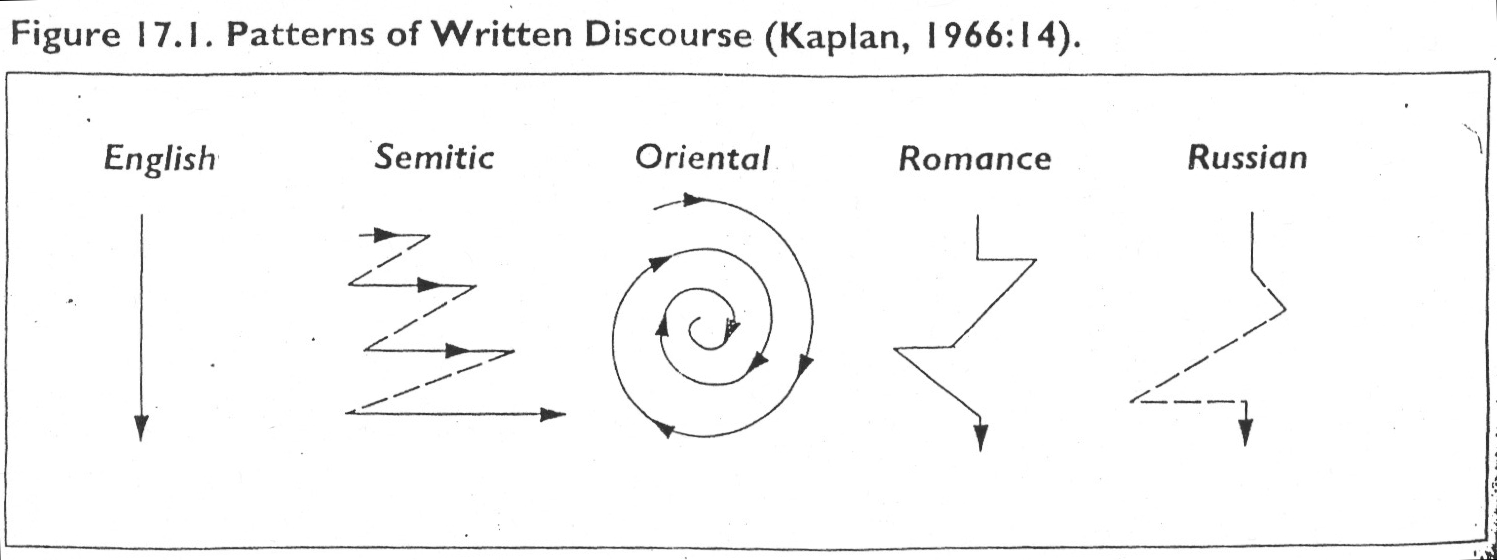
See the Contrative Rhetoric ppt in Google Drive.


ANNOUNCEMENT: No Class on Monday, September 1!